
Impactful Insights
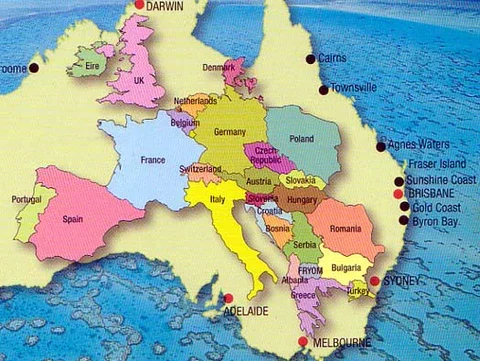
Australia is the 6th largest country in the world, but our population ranks only 55th (~27 million people).
Australia has only ~3.5 people per km² vs Japan’s ~330, making it one of the least densely populated host environments that hosts major events. This creates flow on effects to the operating model for major events that must be accounted for early.
Scale, distance and logistics are not side issues here, they are core challenges that will impact timelines, staffing and budget.
The Rugby World Cup “host country” model sees the Australia 2027 tournament spread across 7 cities. Only 2 (Sydney - Newcastle) are close enough to avoid air transit.
The Brisbane 2032 Master Plan currently lists 8 regional locations beyond the main Brisbane hub, with venues spread along 1,500kms of the Queensland coast (that’s almost the equivalent of a venue spread from London-Barcelona!)
OUR HOST CITY SCALE REQUIRES AN EARLY START
Brisbane will be the smallest Summer host city for the world’s largest sporting event in over 50 years, with the Games to be held in the coolest part of the Australian winter in 2032.
The host regions, scale, distance, density and limited infrastructure create real constraints that need to be factored into plans and budget from the outset.
I remain independent of all major events currently scheduled for Australia and below are just some of the factors that I personally think need to be accounted for:
For Australian organisations
Building to meet international standards takes time, and demand (quality) is highly specific.
Align investment early with what teams actually need
Avoid overbuilding or misaligned capital spend
Secure long-term partnerships that activate well before the Games
For International delegations
The race to secure performance-critical infrastructure in the Games region has already started. Early work has highlighted a shortage of:
Pre-Games training environments and accommodation which do not require a flight to the event.
Local suppliers and operational support on the ground
Logistics, storage, and function space for the multiple groups of event stakeholders
Early access to local networks and on-the-ground insight is critical to securing the right partners, staying ahead of demand and keeping your budget reasonable.
OUR LOCATION REQUIRES A SUSTAINABLE PLANNING SOLUTION
Australia is a long way from pretty much everywhere (except our Oceania cousins!). I am uniquely positioned to understand the challenge of planning for a major event “from 24-hours away” and want to help these events reduce their carbon footprint. Long haul transit will account for a huge proportion of the environmental legacy of these Games and all international stakeholders will need to keep planning visits to a minimum if they are to remain within their sustainability target/kpi/budget.
Adding an experienced, trusted “boots-on-the-ground” Australian agent to your planning team also allows you to:
pivot quickly to new information,
take initiative to get ahead of looming bottlenecks, and
have contingency should an unpredictable regional/global event change the game.
What to expect in 2026:
a growing programme of international sport events to be held in Australia across the next decade;
a finalised sport programme sports from the IOC;
a refinement to event venue plans leading to increased debate about the on-costs to participants.
an influx of international delegations visiting Australia due to a relatively quiet window of the global event cycle before they get stuck in LA traffic until 2029.
a race to secure partnerships with best-in-class local business across the host region.
increased awareness of the sustainability challenge and mitigation guidelines being introduced.
increased pushback from elite athletes and international delegations about events being decentralised and spread too widely across independent venues
INDEPENDENT ADVICE
Major events operate across political, institutional, and commercial pressures, often pulling in different directions. I have sat in the chair of the person with responsibility for delivering their national team to the largest multi-sport Games and I know how challenging this is.
What is communicated publicly is not always what is being discussed privately, and critical decisions are often delayed until full alignment is reached. This can mask real risk and slow the release of information that matters for planning.
Plans can shift quickly. The venue plan is the venue plan, until it isn’t.
As an independent advisor, I operate without institutional bias or delivery conflicts. That allows me to focus on what actually matters, providing clear, candid advice on readiness and risk.
I am not bound by internal messaging or timing. My role is to ensure your planning reflects what is likely to happen, not what is being presented publicly.